


How does the precision planetary gear reducer achieve a perfect balance between "high precision" and "low noise"?
Release Time : 2025-12-29
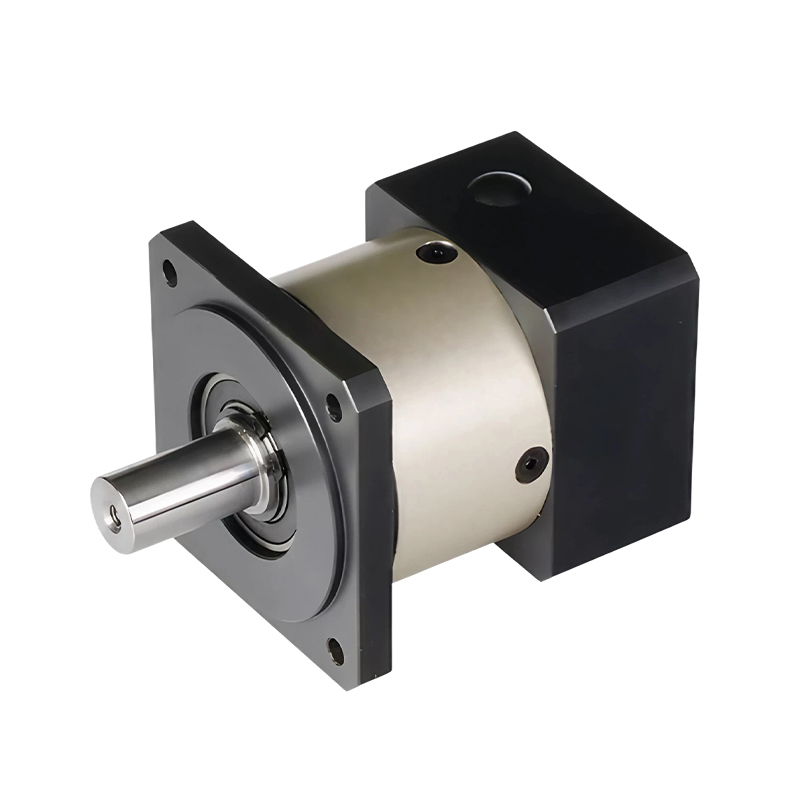
In high-end manufacturing, industrial automation, robotics, and aerospace, the precision planetary gear reducer, as a core transmission component, directly determines the overall machine's operating accuracy, response speed, and service life. Users have extremely stringent requirements: achieving micron-level transmission accuracy while maintaining extremely low operating noise. Through collaborative innovation across multiple dimensions, including materials, structure, processes, and assembly, the precision planetary gear reducer has successfully achieved a perfect balance between "high precision" and "low noise." This article will delve into the implementation path behind this technological marvel.
1. Precision Manufacturing: Controlling Errors at the Source
The foundation of high precision lies in the manufacturing quality of the gears themselves. The precision planetary gear reducer uses high-purity alloy steel, which, after carburizing and quenching or nitriding, achieves a tooth surface hardness of HRC58–62 while maintaining core toughness. Gear machining commonly employs CNC grinding or honing processes, controlling tooth profile errors to the micron level and minimizing cumulative pitch errors. This ultra-precision machining significantly reduces impact and vibration during meshing, fundamentally suppressing noise sources.
2. Optimized Tooth Profile Design: Reduced Meshing Impact
While traditional involute tooth profiles offer smooth transmission, they still exhibit momentary impacts under high-speed, heavy-load conditions. Precision planetary gear reducers often employ modified tooth profiles—including tooth tip edge modification and tooth direction drumming correction—to compensate for thermal deformation, elastic deformation, and assembly errors. This "pre-compensation" design enables gears to achieve a more uniform load distribution and continuous meshing under actual operating conditions, effectively avoiding edge contact and momentary slippage, and significantly reducing high-frequency whistling and mechanical noise.
3. Multi-Tooth Meshing and Uniform Load Distribution: Natural Noise Reduction Advantage
The core advantage of planetary gear structures lies in "power splitting": the sun gear simultaneously drives multiple planet gears, which in turn drive the internal gear ring or output carrier. Typically, 3–5 planet gears are symmetrically arranged, allowing the input torque to be evenly distributed, significantly reducing the load borne by a single tooth pair. Simultaneous meshing of multiple teeth not only improves rigidity and load-bearing capacity but also disperses vibration energy, avoiding concentrated resonance, thus achieving the inherent characteristics of smooth operation and low noise.
4. High-rigidity housing and precision bearing support
The reducer housing adopts an integrated casting or high-rigidity aluminum alloy/cast iron structure. The internal bearing seats are precision machined to ensure minimal coaxiality error of each shaft system. Combined with high-precision angular contact ball bearings or crossed roller bearings, radial and axial movement of the gear shafts is effectively limited. This high-rigidity support system prevents gear misalignment and fretting friction caused by structural flexibility, further suppressing the generation of abnormal noise.
5. Precision assembly and backlash control: The critical "last mile"
Even with extremely high component precision, improper assembly can still lead to performance degradation. Precision planetary reducers employ laser alignment, torque monitoring, and backlash detection during the final assembly stage to control the overall backlash to 1 arcminute or even lower. Ultra-low backlash not only improves positioning accuracy and repeatability but also avoids "idle impact" during reversal, a key factor in achieving silent operation. Some high-end products also employ pre-tightening assembly technology to eliminate internal gaps and achieve "zero backlash" transmission.
6. Lubrication and Sealing: The Invisible Guarantee for Silent Operation
Special low-viscosity, high-extreme-pressure lubricating oil forms a stable oil film, reducing gear surface friction and wear; simultaneously, optimized oil circuit design ensures sufficient lubrication of gears and bearings without generating churning noise. A fully sealed structure prevents dust intrusion and grease leakage, maintaining a long-term stable internal environment and avoiding abnormal noise or precision degradation caused by contamination.
The "high precision" and "low noise" of the precision planetary gear reducer are not accidental, but rather the result of a deep integration of materials science, mechanical design, ultra-precision machining, and intelligent assembly. Like a silent and precise dancer, it maintains elegance and restraint during high-speed operation, providing reliable and quiet power transmission for modern intelligent manufacturing. As Industry 4.0 continues to raise the performance requirements of equipment, this type of precision transmission unit will continue to play an irreplaceable core role.
1. Precision Manufacturing: Controlling Errors at the Source
The foundation of high precision lies in the manufacturing quality of the gears themselves. The precision planetary gear reducer uses high-purity alloy steel, which, after carburizing and quenching or nitriding, achieves a tooth surface hardness of HRC58–62 while maintaining core toughness. Gear machining commonly employs CNC grinding or honing processes, controlling tooth profile errors to the micron level and minimizing cumulative pitch errors. This ultra-precision machining significantly reduces impact and vibration during meshing, fundamentally suppressing noise sources.
2. Optimized Tooth Profile Design: Reduced Meshing Impact
While traditional involute tooth profiles offer smooth transmission, they still exhibit momentary impacts under high-speed, heavy-load conditions. Precision planetary gear reducers often employ modified tooth profiles—including tooth tip edge modification and tooth direction drumming correction—to compensate for thermal deformation, elastic deformation, and assembly errors. This "pre-compensation" design enables gears to achieve a more uniform load distribution and continuous meshing under actual operating conditions, effectively avoiding edge contact and momentary slippage, and significantly reducing high-frequency whistling and mechanical noise.
3. Multi-Tooth Meshing and Uniform Load Distribution: Natural Noise Reduction Advantage
The core advantage of planetary gear structures lies in "power splitting": the sun gear simultaneously drives multiple planet gears, which in turn drive the internal gear ring or output carrier. Typically, 3–5 planet gears are symmetrically arranged, allowing the input torque to be evenly distributed, significantly reducing the load borne by a single tooth pair. Simultaneous meshing of multiple teeth not only improves rigidity and load-bearing capacity but also disperses vibration energy, avoiding concentrated resonance, thus achieving the inherent characteristics of smooth operation and low noise.
4. High-rigidity housing and precision bearing support
The reducer housing adopts an integrated casting or high-rigidity aluminum alloy/cast iron structure. The internal bearing seats are precision machined to ensure minimal coaxiality error of each shaft system. Combined with high-precision angular contact ball bearings or crossed roller bearings, radial and axial movement of the gear shafts is effectively limited. This high-rigidity support system prevents gear misalignment and fretting friction caused by structural flexibility, further suppressing the generation of abnormal noise.
5. Precision assembly and backlash control: The critical "last mile"
Even with extremely high component precision, improper assembly can still lead to performance degradation. Precision planetary reducers employ laser alignment, torque monitoring, and backlash detection during the final assembly stage to control the overall backlash to 1 arcminute or even lower. Ultra-low backlash not only improves positioning accuracy and repeatability but also avoids "idle impact" during reversal, a key factor in achieving silent operation. Some high-end products also employ pre-tightening assembly technology to eliminate internal gaps and achieve "zero backlash" transmission.
6. Lubrication and Sealing: The Invisible Guarantee for Silent Operation
Special low-viscosity, high-extreme-pressure lubricating oil forms a stable oil film, reducing gear surface friction and wear; simultaneously, optimized oil circuit design ensures sufficient lubrication of gears and bearings without generating churning noise. A fully sealed structure prevents dust intrusion and grease leakage, maintaining a long-term stable internal environment and avoiding abnormal noise or precision degradation caused by contamination.
The "high precision" and "low noise" of the precision planetary gear reducer are not accidental, but rather the result of a deep integration of materials science, mechanical design, ultra-precision machining, and intelligent assembly. Like a silent and precise dancer, it maintains elegance and restraint during high-speed operation, providing reliable and quiet power transmission for modern intelligent manufacturing. As Industry 4.0 continues to raise the performance requirements of equipment, this type of precision transmission unit will continue to play an irreplaceable core role.