


How does the RV Worm Gear Reducer balance high torque output and ultra-low noise within a limited space?
Release Time : 2026-01-12
In modern RV design, comfort has long transcended the mere "livability" level, evolving towards a "livable, quiet, and intelligent" mobile living space. Whether it's the slow descent of the electric lift bed, the smooth unfolding of the extension compartment, or the gentle raising and lowering of the awning, these features that enhance the experience are often driven silently by a compact RV Worm Gear Reducer. The challenges it faces are particularly stringent: it must output sufficient torque to propel loads of tens or even hundreds of kilograms within a confined equipment compartment or floor space, while simultaneously operating almost silently in the dead of night—because any slight noise could shatter the traveler's expectation of a "peaceful night." It is under the tension of these contradictory demands that the RV Worm Gear Reducer achieves a harmonious coexistence of power and quietness through its ingenious mechatronics design.
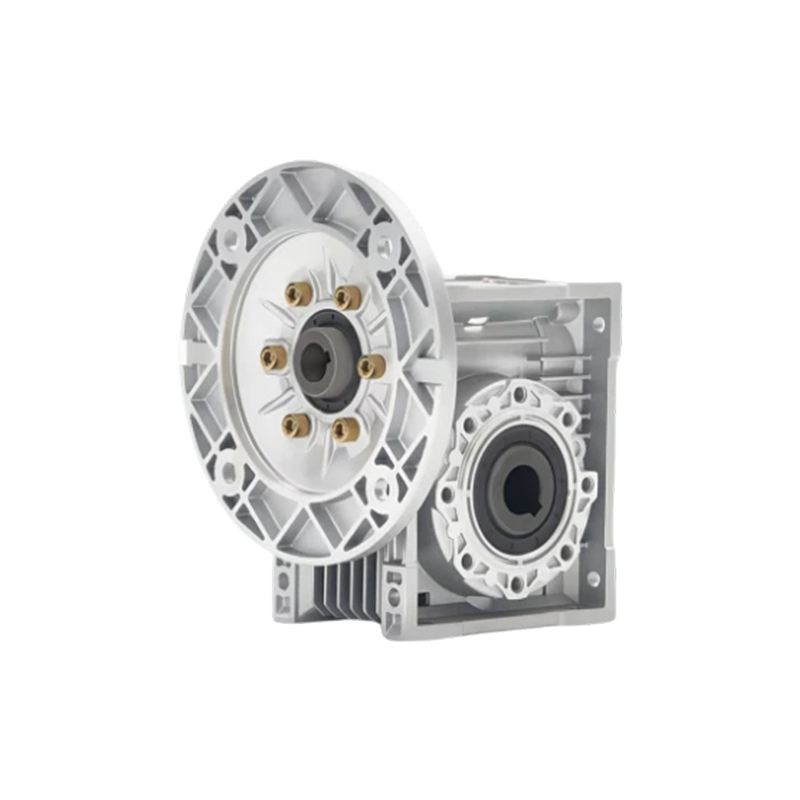
The core advantage of the RV Worm Gear Reducer stems primarily from the inherent characteristics of worm gear transmission. The meshing between the worm and worm wheel involves a sliding-rolling composite motion with multiple teeth in simultaneous contact. Compared to the point-to-line impact of gear transmission, its power transmission is more continuous and smooth, fundamentally suppressing the generation of vibration sources. More importantly, this structure possesses a high reduction ratio and self-locking capability—only one stage of transmission is needed to convert the high-speed, low-torque motor into low-speed, high-torque output shaft, saving the space occupied by multiple stages of gear stacking; while the self-locking characteristic ensures that the mechanism will not retract due to gravity in the event of a power outage, eliminating the need for additional braking devices, further simplifying the structure and reducing potential noise points.
However, the advantages of the principle alone are not enough to achieve "ultra-low noise." True quiet performance relies on meticulous attention to detail. For example, the helical surface of the worm needs to be precision ground and polished to ensure uniform contact with the worm wheel teeth, avoiding localized stress concentration that could cause micro-vibrations; the worm wheel often uses tin bronze or high-performance engineering plastic composite materials, which not only reduce the coefficient of friction but also absorb high-frequency sound waves, acting as a "sound-absorbing pad"; and the internal housing optimizes the oil passages and chamber shape to form a stable oil film that provides both lubrication and damping. These design elements work together to transform the metallic meshing sound into a barely audible, soft airflow noise.
In the space-constrained environment of a motorhome, integrated layout is equally crucial. Modern motorhome RV worm gear reducers often highly integrate the motor, reduction gear, sealing unit, and even control circuitry into a single unit, reducing external connectors and transmission clearances. Their compact shape allows them to be embedded in furniture frames or chassis gaps, away from the sleeping area; while the fully enclosed structure effectively isolates internal operating noise from propagating outwards. Some high-end products also incorporate flexible vibration-damping mounts to further cut off the transmission path of vibrations to the body panels.
Furthermore, intelligent control strategies enhance quietness. Through soft-start algorithms, the motor avoids mechanical shocks caused by sudden current changes during start-up and shutdown; during low-speed operation, the control system dynamically adjusts power output, providing just enough torque to avoid structural resonance caused by excessive force. This "just right" driving method allows the lift bed to descend slowly in the dead of night as quietly as moonlight.
Of course, behind all this lies a profound understanding of the matching of materials, processes, and systems. From the heat-treated and reinforced worm gear core to the selection of aging-resistant sealing rings, and the control of the cleanliness of the assembly environment, every step affects the final NVH (noise, vibration, and harshness) performance.
In conclusion, the RV worm gear reducer's ability to balance power and quietness within its compact size is not a victory of a single technology, but rather the result of collaborative innovation in mechanical principles, materials science, precision manufacturing, and intelligent control. It is unassuming, yet silently and reliably supports every comfortable stretch; it is quiet, yet protects the most precious tranquility of travelers in the still of the night. In this era that pursues a "mobile home," a small reducer, with its spirit of meticulous craftsmanship, embodies the beauty of engineering that is "subtle and pervasive."
The core advantage of the RV Worm Gear Reducer stems primarily from the inherent characteristics of worm gear transmission. The meshing between the worm and worm wheel involves a sliding-rolling composite motion with multiple teeth in simultaneous contact. Compared to the point-to-line impact of gear transmission, its power transmission is more continuous and smooth, fundamentally suppressing the generation of vibration sources. More importantly, this structure possesses a high reduction ratio and self-locking capability—only one stage of transmission is needed to convert the high-speed, low-torque motor into low-speed, high-torque output shaft, saving the space occupied by multiple stages of gear stacking; while the self-locking characteristic ensures that the mechanism will not retract due to gravity in the event of a power outage, eliminating the need for additional braking devices, further simplifying the structure and reducing potential noise points.
However, the advantages of the principle alone are not enough to achieve "ultra-low noise." True quiet performance relies on meticulous attention to detail. For example, the helical surface of the worm needs to be precision ground and polished to ensure uniform contact with the worm wheel teeth, avoiding localized stress concentration that could cause micro-vibrations; the worm wheel often uses tin bronze or high-performance engineering plastic composite materials, which not only reduce the coefficient of friction but also absorb high-frequency sound waves, acting as a "sound-absorbing pad"; and the internal housing optimizes the oil passages and chamber shape to form a stable oil film that provides both lubrication and damping. These design elements work together to transform the metallic meshing sound into a barely audible, soft airflow noise.
In the space-constrained environment of a motorhome, integrated layout is equally crucial. Modern motorhome RV worm gear reducers often highly integrate the motor, reduction gear, sealing unit, and even control circuitry into a single unit, reducing external connectors and transmission clearances. Their compact shape allows them to be embedded in furniture frames or chassis gaps, away from the sleeping area; while the fully enclosed structure effectively isolates internal operating noise from propagating outwards. Some high-end products also incorporate flexible vibration-damping mounts to further cut off the transmission path of vibrations to the body panels.
Furthermore, intelligent control strategies enhance quietness. Through soft-start algorithms, the motor avoids mechanical shocks caused by sudden current changes during start-up and shutdown; during low-speed operation, the control system dynamically adjusts power output, providing just enough torque to avoid structural resonance caused by excessive force. This "just right" driving method allows the lift bed to descend slowly in the dead of night as quietly as moonlight.
Of course, behind all this lies a profound understanding of the matching of materials, processes, and systems. From the heat-treated and reinforced worm gear core to the selection of aging-resistant sealing rings, and the control of the cleanliness of the assembly environment, every step affects the final NVH (noise, vibration, and harshness) performance.
In conclusion, the RV worm gear reducer's ability to balance power and quietness within its compact size is not a victory of a single technology, but rather the result of collaborative innovation in mechanical principles, materials science, precision manufacturing, and intelligent control. It is unassuming, yet silently and reliably supports every comfortable stretch; it is quiet, yet protects the most precious tranquility of travelers in the still of the night. In this era that pursues a "mobile home," a small reducer, with its spirit of meticulous craftsmanship, embodies the beauty of engineering that is "subtle and pervasive."