
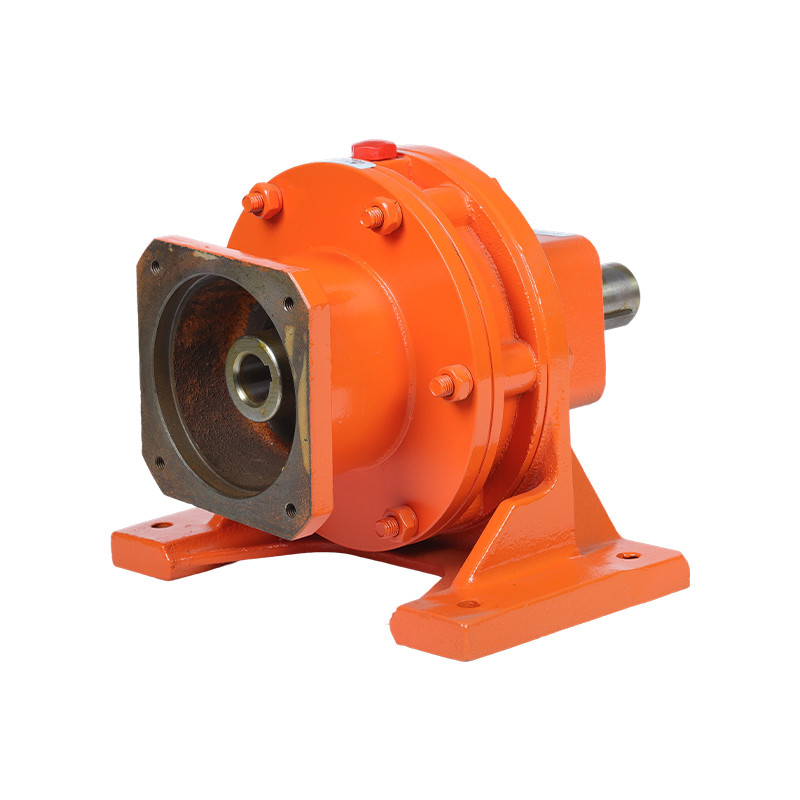


What is the design principle of the cycloidal pinwheel reducer's tooth profile?
Release Time : 2025-10-29
The cycloidal pinwheel reducer's cycloidal gear tooth profile design is based on a unique combination of planetary transmission theory and cycloidal meshing. Its core principle is to achieve efficient and smooth power transmission through a specific geometric curve. This design uses the equidistant curve of a short-amplitude epicycloid as the tooth profile foundation. Combined with the precise arrangement of pin teeth, this creates a unique internal meshing structure with a small tooth difference. This design not only overcomes the limitations of traditional gear transmissions but also offers significant advantages in load capacity, transmission efficiency, and operational smoothness.
The cycloidal gear tooth profile is generated by the pure rolling motion of the generating circle on the base circle. When the generating circle diameter is smaller than the base circle, the trajectory of fixed points on it forms a short-amplitude epicycloid. If a series of arcs are drawn with each point on this cycloid as the center and the pin tooth diameter as the radius, the envelope curve represents the actual cycloidal gear tooth profile. This tooth profile ensures that the meshing points between the cycloid and the pin teeth are in a constant state of rolling friction, significantly reducing friction losses. At the same time, properly selecting the short-width coefficient is crucial to tooth profile quality. An excessively large value can lead to a surge in contact stress on the tooth surfaces, causing increased wear; a too small value can concentrate stress at the contact points, shortening transmission life.
The pin pin distribution precisely matches the tooth profile design. The pin pins are evenly spaced along the inner circumference of the pin housing, with the ratio of their distribution circle diameter to the pin tooth diameter optimized using the pin diameter coefficient. This design ensures that multiple teeth are always engaged during cycloidal wheel rotation, allowing theoretically approximately half of the pin teeth to carry load simultaneously. This multi-tooth engagement not only ensures uniform load distribution but also significantly improves transmission accuracy through error averaging, making the cycloidal pinwheel reducer a key player in the precision transmission field.
The staggered arrangement of the two cycloidal wheels is a key innovation in improving load capacity. The two cycloidal wheels are spatially offset by 180 degrees, creating a dynamically balanced structure. When the input shaft rotates the eccentric sleeve, the forces acting on the two cycloidal wheels are in opposite directions, offsetting some of the inertial forces and thus reducing vibration and noise. This design also enables the reducer to withstand greater radial and axial loads, expanding its application range under heavy-duty conditions.
Tooth profile modification technology further optimizes transmission performance. To avoid tooth tip interference caused by machining errors, the theoretical tooth profile requires local correction. By optimizing the modification curve, the tooth tip point is eliminated while preserving the original transmission characteristics, improving the continuity and smoothness of the tooth profile. This design improvement not only reduces transmission noise but also enhances the reducer's stability at high speeds.
The cycloidal pinwheel reducer's transmission ratio calculation is based on the principle of tooth number difference. The transmission ratio formula is i = -Zp/(Zc - Zp), where Zp is the number of pins and Zc is the number of cycloidal gear teeth. The negative sign indicates opposite input and output directions. This design enables single-stage transmission ratios ranging from 11 to 87, and two-stage transmission ratios exceeding 5000, meeting the urgent demand for large reduction ratios in the industrial sector.
The cycloidal pinwheel reducer, with its unique tooth profile design and planetary transmission principle, demonstrates outstanding performance in mechanical transmission. From tooth profile generation to multi-tooth meshing, from dynamic balancing to tooth form correction, every design detail reflects the pursuit of efficient and smooth transmission. This design not only gives the reducer advantages such as compact structure, large transmission ratio, and high efficiency, but also enables its widespread application in high-end fields such as robotics, aerospace, and precision machine tools, making it an indispensable core component in modern industry.